


Choosing Aluminum Profiles is not just a matter of picking a shape from a catalogue. The right section must carry the expected load, fit the assembly, and withstand its working environment. A slim channel may suit a lightweight equipment frame, while a thicker, closed section can resist twisting. Small details matter. Wall thickness, alloy, temper, finish, and corner geometry all influence performance, cost, and lead time.
Professor Michael F. Ashby, a leading materials-selection expert, offers a useful way to think about the decision. The following is a paraphrase of his materials-selection approach, not a verbatim quotation: “Match the material to the job, not to a headline property.” That principle helps keep profile selection grounded in real requirements. A strong alloy may be unnecessary if the design needs easy machining or reliable anodizing. And a standard extrusion can sometimes solve the problem more simply than a custom die. Not always obvious.
This guide explains how to define project loads, compare profile shapes, and assess alloy and temper choices. It also considers finish, tolerances, fabrication, supplier capability, and total cost—not just the price per metre. Before requesting a quote, sketch connection points and note where bolts, panels, or brackets will sit. A small oversight here can complicate assembly later. Specifications are useful, but they are not perfect; prototypes may reveal assumptions that drawings miss. The goal is a profile that works in the finished project, not merely one that looks right on paper.
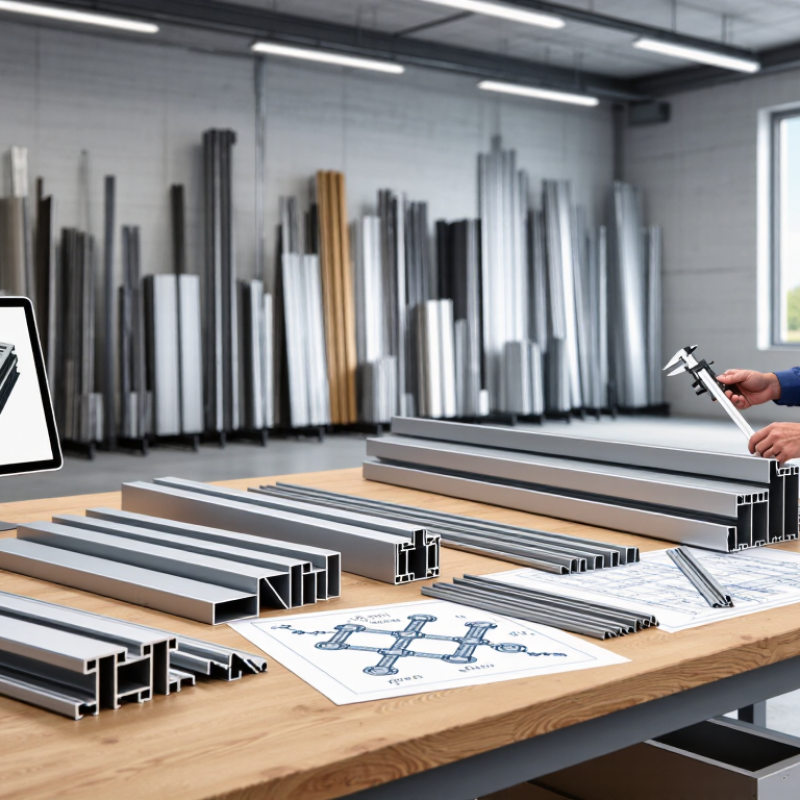
Before selecting an aluminum profile, define what it must carry and where it will operate. A shelf frame holding light panels needs different wall thickness and joint support than a machine guard exposed to vibration. Estimate static loads, impacts, unsupported spans, and connection forces; then check the profile’s section properties against the design. A thicker-looking extrusion is not automatically stronger. Cutouts and poorly placed fasteners can weaken it.
The environment matters just as much. Outdoor frames may face rain, salt spray, temperature swings, or trapped moisture inside joints. Specify an alloy and surface finish suited to those conditions, and consider drainage and dissimilar-metal contact during detailing. The International Energy Agency’s 2023 aluminium-sector assessment reports that aluminium production accounts for roughly 2% of global energy-related emissions. That makes recycled content and supplier-specific environmental data useful questions, not decorative claims. Ask for documented material composition and recycled-content figures. Check the evidence. I have seen projects focus on load ratings, then overlook corrosion at a cut edge. That small omission can shorten service life. Define loads, exposure, service life, and maintenance access before comparing profiles.
| Project requirement | What to define | Useful data or selection guidance | What to verify |
|---|---|---|---|
| Loads and load direction | Identify the forces acting on the profile, including their direction, duration, and whether they are static, repeated, or impact loads. | Record loads in newtons (N) or kilonewtons (kN). A vertical post, a horizontal beam, and a profile loaded in torsion may need different cross-sections. | Calculate stress and deflection for the actual load case. Do not select a profile from outside dimensions alone. |
| Span and support conditions | Measure the unsupported length and specify whether the profile is simply supported, fixed, or cantilevered. | Longer spans generally increase deflection; a cantilever is typically more demanding than a beam supported at both ends. | Check the profile’s section properties, especially second moment of area, against the chosen span and support model. |
| Stiffness and allowable deflection | Set a maximum acceptable movement based on function, appearance, clearances, and connected components. | Aluminum alloys have an elastic modulus of about 69 GPa. For the same load and geometry, stiffness depends strongly on cross-section shape and orientation. | Compare calculated deflection with the project’s specified limit; allowable limits vary by application and are not universal. |
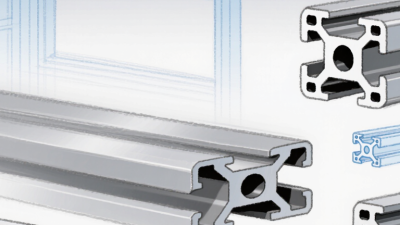
| Profile geometry and connections | Define overall dimensions, wall thickness, grooves, holes, cut-outs, and how the profile will connect to other parts. | Open sections are generally easier to access but may twist more; closed or multi-cell sections can offer greater torsional stiffness, depending on their design. | Check local stresses around fasteners and openings, bearing surfaces, joint slip, and whether loads transfer through the intended faces. |
| Alloy and temper | Specify the required strength, formability, machinability, weldability, and finish compatibility. | 6063 is commonly used for architectural and general-purpose extrusions; 6061 is often selected where higher strength or machining performance is needed. Properties depend on temper and section thickness. | Use certified material properties for the exact alloy, temper, product form, and applicable specification. Welding can reduce strength in heat-affected areas. |
| Operating environment | Describe exposure to rain, humidity, salt, chemicals, cleaning agents, soil, and industrial pollutants. | Aluminum forms a protective oxide layer, but corrosion performance depends on alloy, exposure, surface condition, and contact with other materials. | For marine or chemical exposure, assess the alloy and finish for the specific environment. Prevent or isolate contact with dissimilar metals where galvanic corrosion is possible. |
| Temperature and thermal movement | Set the expected minimum and maximum temperatures and identify temperature changes across the assembly. | Aluminum’s linear thermal expansion coefficient is approximately 23 µm/(m·°C). A 1 m length changes by about 2.3 mm for a 100°C temperature change. | Allow for expansion in long runs and check how temperature affects joints, clearances, seals, and adjacent materials. |
| Weight and handling | Set a target mass for the profile and the complete assembly, including connectors and fasteners. | Aluminum density is approximately 2.70 g/cm³ (2,700 kg/m³). Actual profile mass per metre depends on its cross-sectional area and alloy. | Use the supplier’s mass-per-length data for the exact profile and include all hardware in handling and support calculations. |
| Finish and service life | Define appearance, wear resistance, cleanability, and the expected maintenance interval. | Common options include mill finish, anodizing, and powder coating. Suitability depends on the exposure, required appearance, and fabrication sequence. | Confirm coating or anodizing requirements, edge coverage, repair method, and compatibility with cutting, drilling, and joining. |
| Codes and safety factors | Identify the project location, governing design rules, safety factors, and any certification or inspection requirements. | Required checks can include yielding, buckling, fatigue, deflection, connection capacity, and stability. Applicable rules depend on the structure and jurisdiction. | Have a qualified designer verify the final profile, connections, loads, and material data against the applicable codes and project specifications. |
Note: The values shown are typical reference figures for initial planning. Final selection should use verified material data and calculations for the specific profile, load case, and environment.



 wechat
