


Choosing the right Aluminum Frame Extrusion Profiles in 2026 requires more than comparing catalog photographs. A strong selection must match load requirements, assembly methods, surface conditions, and long-term operating environments. T-slot profiles may simplify adjustments, while custom hollow sections can reduce weight and improve stiffness. The best choice depends on evidence.
Robert L. Ferry, a respected aluminum extrusion engineer and co-author of The Extrusion of Aluminum, describes the process as “forcing aluminum through a die to produce a continuous profile.” That simple explanation reveals an important design truth: the die shape controls much of the profile’s performance, cost, and usability. Engineers should examine alloy, temper, wall thickness, corner radii, dimensional tolerances, and finishing options before approving a profile.
Small details matter.
In 2026, 6063-T5 remains popular for modular frames, clean architectural finishes, and general equipment structures. 6061-T6 may suit applications requiring higher strength, although machining and surface appearance can differ. Thermal-break profiles deserve attention in façades and energy-conscious enclosures. Recycled aluminum, traceable billet sourcing, and supplier quality records are also becoming practical purchasing factors.
Still, no profile is perfect. A heavier section may improve rigidity but increase cost and handling effort. A narrow wall may look efficient yet distort during fabrication. Even published specifications require verification through drawings, samples, and supplier testing. This guide compares leading Aluminum Frame Extrusion Profiles using practical criteria, not marketing language, while acknowledging that real projects often expose weaknesses that product tables miss.
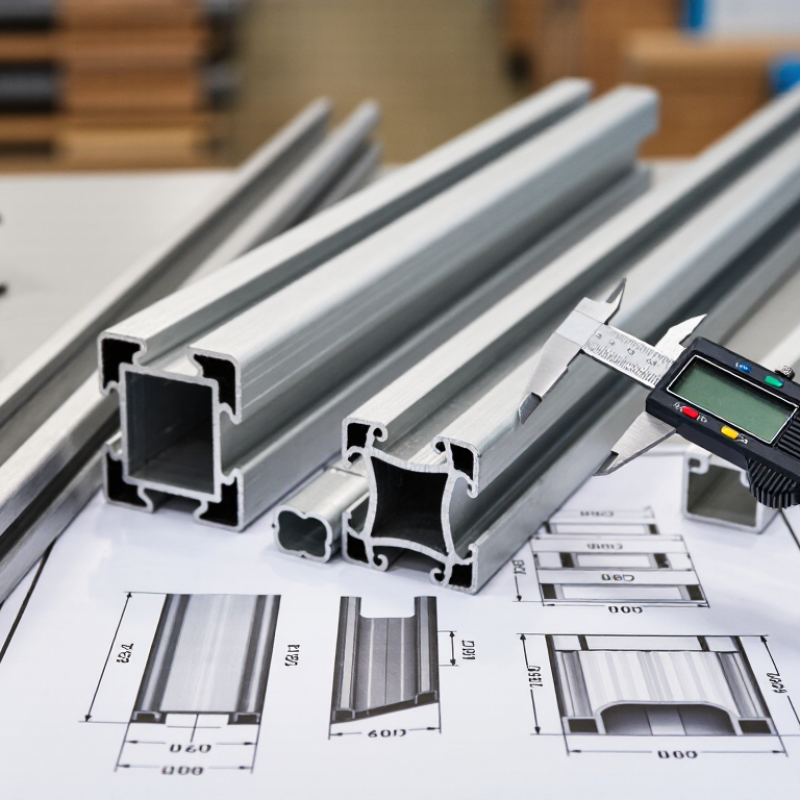
Aluminum frame extrusion profiles are classified by cross-section, slot geometry, and intended load. Common families include T-slot profiles, square and rectangular tubes, angle sections, and custom structural shapes. T-slot profiles have grooves along one or more faces, allowing brackets and panels to attach without drilling. Tube profiles offer a cleaner exterior, while angles suit simple corner supports. The right section depends on span, load, connection method, and available space—not appearance alone.
Slot series also matter. A profile’s groove width and dimensions determine which fasteners and connectors fit, so similar-looking sections are not always interchangeable. Engineers typically check dimensions, tolerances, and mechanical properties against standards such as EN 755 for extruded aluminum products. The World Aluminium Statistical Review 2024 reports global primary aluminum production of about 70.6 million tonnes in 2023. That figure reflects the material’s industrial scale, but it does not identify a best profile; selection still requires application-specific checks. A thin profile may look sufficient on a short bench, then flex across a longer machine frame. I’ve seen that detail overlooked. Be cautious: catalog load ratings may rely on particular spans and support conditions, not your exact assembly.
| Profile Classification | Typical Section Example | Common Slot or Mounting Feature | Typical Alloy and Finish | Common Applications | Selection Considerations |
|---|---|---|---|---|---|
| Light-duty modular T-slot | 20 × 20 mm square profile | Usually a 6 mm T-slot system; confirm nut and connector compatibility | Often 6063-T5; clear or black anodized finishes are common | Small fixtures, sensor mounts, lightweight enclosures, and desktop frames | Compact and easy to assemble, but generally less rigid than larger sections. Check the manufacturer’s load data for the specific profile. |
| General-purpose modular T-slot | 30 × 30 mm square profile | Commonly a 6 mm or 8 mm slot, depending on the system | Often 6063-T5; anodized or mill-finish options may be available | Workstations, guards, light machine frames, and display structures | A practical middle ground for modest loads. Slot size and connector patterns vary, so match all hardware to one system. |
| Standard structural T-slot | 40 × 40 mm square profile | Commonly an 8 mm T-slot system | Often 6063-T5 or 6063-T6; anodizing is common | Machine frames, workbenches, equipment supports, and safety guarding | A widely used general-purpose size. Compare section geometry, unsupported span, joint design, and deflection limits before selection. |
| Wide-span structural T-slot | 40 × 80 mm rectangular profile | Often 8 mm slots on multiple faces; confirm the exact layout | Often 6063-T5 or 6063-T6; anodized finishes are common | Long rails, machine bases, conveyor supports, and larger frame members | The deeper section can improve stiffness in one orientation. Install it with the stronger bending axis aligned to the expected load. |
| Heavy-duty modular T-slot | 45 × 45 mm square profile | Commonly a 10 mm T-slot system | Often 6063-T5 or 6063-T6; finish depends on the application | Heavy machine frames, automation equipment, and robust workstations | Offers a larger connection system than light-duty profiles, but hardware is not necessarily interchangeable with 6 mm or 8 mm slot systems. |
| Large-section structural profile | 50 × 50 mm square profile | Slot size and pattern depend on the product family | Often 6063-T5 or 6063-T6; anodized or mill finish | High-stiffness frames, substantial supports, and large equipment enclosures | Useful where larger section dimensions are needed. Verify connection strength, allowable loads, and deflection rather than choosing by outside dimensions alone. |
| Rectangular or closed-section profile | Examples include 30 × 60 mm or 60 × 60 mm sections | May have T-slots, plain faces, or a partially enclosed cross-section | Commonly 6063-series alloys; finish varies with end use | Frames requiring directional stiffness, clean exterior faces, or integrated channels | Check orientation, access for fasteners, and whether the internal geometry supports the intended connectors and accessories. |
| Architectural or smooth-face profile | Face dimensions vary by system and design | Typically hidden channels, screw ports, or dedicated joinery features rather than exposed T-slots | Often 6063-T5 or 6063-T6; anodized and powder-coated finishes are common | Partitions, display systems, furniture, and architectural framing | Prioritize finish, appearance, weather exposure, and compatible joining details. Structural capacity must be assessed for the specific design. |
Note: Dimensions and slot sizes shown are representative examples, not a universal standard. Similar-looking profiles may use incompatible nuts, brackets, and connectors. Alloy temper, wall thickness, cross-section geometry, span, joints, and loading conditions all affect strength and deflection; consult technical data for the exact profile before specifying it.





 wechat