One Stop Solution For Aluminum Profiles
调查
表单加载...

What Are the 2026 Top Types of Aluminum Profiles?

What Are the 2026 Top Types of Aluminum Profiles? This question matters to architects, fabricators, and buyers planning durable structures. Aluminum Profiles now support curtain walls, machine frames, solar systems, transport equipment, and interior designs. Their value depends on more than appearance. Alloy selection, cross-section shape, wall thickness, surface treatment, and connection methods all influence performance.

This guide examines the leading Aluminum Profiles expected to shape projects in 2026. It considers standard T-slot profiles, structural profiles, thermal-break systems, solar mounting profiles, sliding-door profiles, and customized extrusions. Each type serves a different purpose. A T-slot frame may simplify assembly, while a thermal-break profile can reduce heat transfer around a building opening. Small details matter.

Real project experience often reveals the difference. A profile that looks strong may twist under repeated loads. A polished finish may still fail in a coastal environment without suitable protection. Engineers should check load calculations, tolerances, alloy grades, and relevant product standards before ordering. Suppliers should also provide reliable drawings, test data, and traceable specifications.

The market is changing quickly.

However, “top” does not always mean most popular. It may mean safest, lightest, easiest to install, or most efficient over its service life. This article compares these practical factors and highlights where each profile performs well. Some recommendations may need adjustment as manufacturing methods and sustainability requirements develop. That uncertainty deserves honest attention.

What Are the 2026 Top Types of Aluminum Profiles?

What Defines Aluminum Profiles in 2026?

In 2026, aluminum profiles are defined by performance, traceability, and lower environmental impact. The familiar categories remain important: architectural extrusions, thermal-break frames, T-slot systems, structural profiles, and solar-mounting sections. Yet their value now depends on measurable details. Alloy selection affects strength. Wall thickness affects weight and machining. Surface treatment affects corrosion resistance and service life.

The International Aluminium Institute reports that recycled aluminum needs roughly 5% of the energy required for primary aluminum production. This makes recycled content a major design factor. However, recycled material is not automatically better. Engineers must verify alloy consistency, contamination controls, and documented material origins. A certificate alone may not reveal every production weakness.

The International Energy Agency estimates that aluminum production creates about 3% of global energy-related carbon dioxide emissions. That pressure is changing profile design. Manufacturers increasingly specify lightweight geometries, tighter tolerances, and digital batch records. Thermal-break profiles also matter in buildings, especially where energy codes demand improved insulation. Small gaps matter.

In practical projects, a good profile should fit the load, climate, joining method, and maintenance plan. It should also allow efficient cutting, drilling, and recycling after use. This sounds obvious, but many specifications still prioritize appearance over lifecycle performance. That is a mistake worth challenging. In 2026, the strongest definition is not simply “extruded aluminum.” It is verified performance with evidence.

How Aluminum Profiles Are Classified by Shape and Function

What Are the 2026 Top Types of Aluminum Profiles?

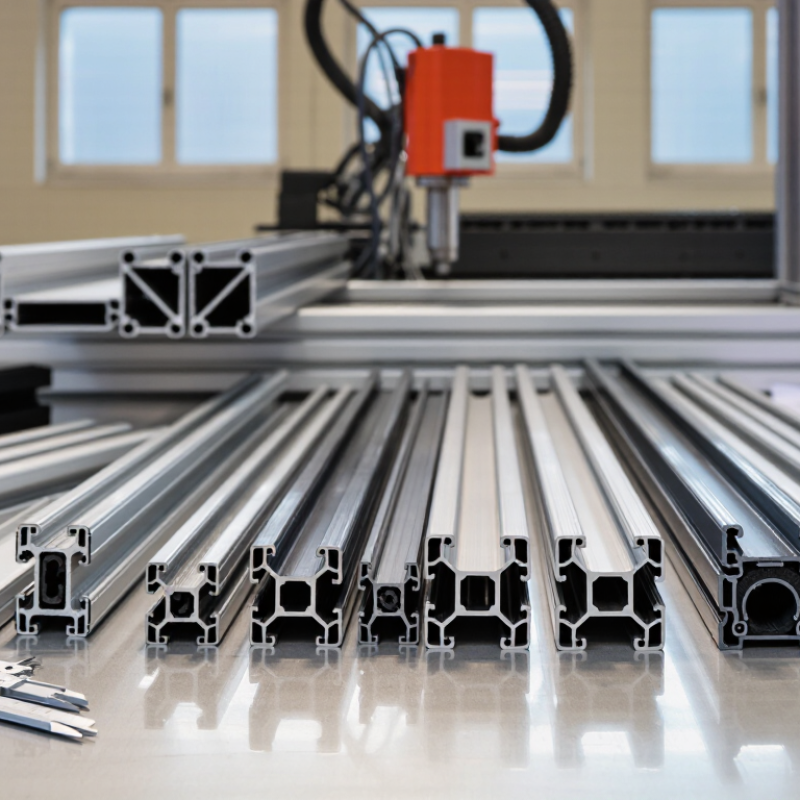
Aluminum profiles are classified by shape and function, not by appearance alone. Solid profiles include flat bars, round rods, and square sections. Hollow profiles contain one or more internal cavities. They reduce weight while maintaining useful stiffness. Semi-hollow designs combine open spaces with thick supporting walls. T-slot profiles add continuous grooves for frames, guards, and adjustable workstations. Angles, channels, and beams suit simpler structural connections. Custom extrusions follow a specific die design. ASTM B221 provides widely used requirements for extruded aluminum profiles, including mechanical properties and dimensional tolerances.

Function creates another practical classification. Structural profiles support machine frames, platforms, and lightweight building systems. Architectural profiles form window frames, curtain-wall parts, trims, and doors. Thermal profiles use fins to increase surface area around heat sources. Electrical profiles may carry housings, busbar supports, or cable-management components. Transport profiles often combine thin walls with carefully placed ribs. The International Aluminium Institute reported global primary aluminum production of about 72 million tonnes in 2024, showing the material’s continuing industrial scale. Its technical studies also note that recycled aluminum requires roughly 5% of primary production energy.

Classification is useful, but never perfect. A hollow profile can be structural and thermal. A T-slot section can serve automation or retail fixtures. Designers must check load, alloy, wall thickness, joining method, and corrosion exposure. Small details matter. In practice, early classification can still miss assembly problems. A profile that looks efficient may twist under uneven loading. Testing remains necessary.

What Are the 2026 Top Types of Aluminum Profiles?

Aluminum profiles are commonly classified by cross-sectional shape and intended function. The chart compares representative wall-thickness values frequently used in general architectural, framing, and thermal-management applications.

T-slot and hollow profiles are widely used for modular structures, while angles and channels suit brackets and edge supports. Heat-sink profiles use finned shapes to increase surface area, and curtain-wall mullions combine structural support with glazing integration. Actual dimensions vary according to load, span, alloy, extrusion die, and applicable standards.

Which Aluminum Profile Types Lead Different Industries in 2026?

In 2026, aluminum profile demand is being shaped by practical industry needs, not fashion.

T-slot profiles lead factory automation because teams can build frames, guards, and workstations quickly. Structural profiles support facades, doors, and lightweight partitions. Their appeal comes from clean surfaces and predictable assembly.

Heat-sink profiles remain vital in electronics and battery equipment. Their fins spread heat across a larger area, but poor airflow can still reduce performance. Solar mounting profiles also continue growing. They need accurate slots, corrosion resistance, and stable joints under changing weather.

Automotive manufacturers favor lightweight extruded sections for frames, rails, and interior structures. However, thinner walls are not automatically better. I have seen designs fail because stiffness was estimated too casually.

Tips: Match the profile shape to its load, span, and environment. Check alloy, temper, wall thickness, tolerances, and surface treatment. For outdoor systems, test drainage and fastener compatibility. Request dimensional reports and sample assemblies before production. Small gaps matter. A profile that fits perfectly on paper may bind after cutting or coating.

Architectural profiles prioritize appearance, while industrial profiles prioritize repeatability and service access. Designers should compare bending strength, connection methods, machining limits, and replacement needs. Standard shapes often reduce cost, yet custom extrusion can solve awkward loads more efficiently. The right choice depends on measured conditions, not a catalog image.

How Surface Finishes and Alloys Affect Profile Selection

What Are the 2026 Top Types of Aluminum Profiles?
How Surface Finishes and Alloys Affect Profile Selection

In 2026, architectural, industrial, heat-sink, and modular profiles remain widely specified. Alloy choice should follow load, exposure, and machining needs. The 6000 series is usually the practical foundation. Alloy 6063 offers smooth extrusion surfaces and consistent anodizing for doors, façades, and interior trims. Alloy 6061 provides higher strength for frames, brackets, and equipment supports. For heavier structural demands, 6082 can be more suitable, although its finish may appear less uniform.

Surface treatment changes both performance and appearance. Anodizing creates a controlled oxide layer that improves corrosion resistance and retains a metallic texture. Powder coating provides broader color options and stronger visual coverage, but poor pretreatment can cause peeling near cut edges. Mill finish is cheaper, yet it exposes scratches and oxidation quickly. Not every shiny profile is durable.

The International Aluminium Institute reports that recycled aluminum requires about 5% of the energy used for primary aluminum production. That figure makes recycled-content profiles attractive, but alloy separation still matters. Mixed scrap can reduce consistency. ASTM B221 remains a useful reference for extruded aluminum dimensions and mechanical requirements. In practice, I inspect corners, holes, and exposed ends before approval. Small defects become obvious under bright lighting. I have also seen specifications overemphasize color while ignoring alloy temper. That is a costly mistake.

What Are the 2026 Top Types of Aluminum Profiles? — How Surface Finishes and Alloys Affect Profile Selection
Profile Type Common Alloy and Temper Typical Surface Finish Key Characteristics Typical Applications Main Selection Advantage Important Limitations 2026 Market Relevance
Architectural Window and Door Profiles 6063-T5 or 6063-T6
6060-T5 for highly detailed sections
Anodized Powder coated PVDF coated Excellent extrusion surface quality, good corrosion resistance, moderate strength, and strong suitability for complex hollow sections. Residential windows, commercial doors, sliding systems, partition frames, and thermally improved fenestration systems. Balances appearance, dimensional accuracy, extrudability, and long-term weather resistance. Lower structural strength than 6061-T6 or 6082-T6; thermal bridging may require polyamide thermal breaks. High demand due to energy-efficient building envelopes and durable low-maintenance finishes.
Curtain Wall and Façade Profiles 6063-T5/T6
6005A-T6 for higher load requirements
Anodized Powder coated PVDF coated Lightweight, corrosion resistant, visually consistent, and adaptable to mullions, transoms, pressure plates, and cover caps. Unitized and stick curtain walls, rainscreens, storefronts, skylights, and ventilated façades. Provides a high strength-to-weight ratio while supporting architectural color and texture requirements. Structural design must account for wind pressure, deflection, fasteners, joints, and galvanic contact with other metals. Important for sustainable façades, refurbishment, solar-integrated façades, and reduced operational energy use.
T-Slot Modular Framing Profiles 6063-T5 or 6063-T6
6105-T5 in selected structural designs
Clear anodized Black anodized Mill finish Precise grooves and channels allow adjustable mechanical connections without welding or extensive machining. Machine guards, automation frames, workstations, conveyors, laboratory structures, and modular enclosures. Fast assembly, reconfiguration, part reuse, and compatibility with a wide range of brackets and fasteners. Grooves and joints can reduce rigidity compared with welded steel or fully machined frames; connection design is critical. Strong relevance in flexible automation, robotics, factory retrofits, and rapidly reconfigurable production lines.
Structural Extruded Profiles 6061-T6
6005A-T6
6082-T6 where available and appropriate
Mill finish Anodized Powder coated Higher yield strength than typical 6063 architectural profiles, with good machinability and useful weldability. Frames, supports, platforms, vehicle structures, ladders, equipment bases, and industrial assemblies. Reduces weight while providing dependable load-bearing performance and efficient machining. More difficult to extrude into very intricate shapes; welded areas may lose strength in heat-treated alloys. Widely used where lightweighting, modular construction, and corrosion resistance are required together.
Heat-Sink and Thermal Management Profiles 6063-T5/T6
6060-T5 for fine fins and detailed geometries
Mill finish Black anodized Clear anodized High thermal conductivity, good fin-forming capability, and efficient production of complex extruded cooling geometries. LED luminaires, power electronics, battery systems, motor drives, telecommunications equipment, and industrial controls. Integrates heat dissipation with a lightweight structural part and avoids secondary assembly in many designs. Performance depends on fin spacing, airflow, contact resistance, orientation, and the actual thermal load. Increasingly important for electric mobility, data infrastructure, power conversion, and compact electronics.
Solar Mounting and Rail Profiles 6005A-T6
6063-T6 for lighter-duty rails and clamps
Mill finish Anodized Powder coated Good structural efficiency, outdoor corrosion resistance, and compatibility with slotted channels and mechanical fasteners. Rooftop photovoltaic rails, ground-mount systems, module frames, cable channels, and solar carports. Low mass, rapid installation, and strong resistance to normal atmospheric exposure. Must be checked for wind uplift, snow loads, thermal movement, roof compatibility, and galvanic corrosion at connections. High relevance as distributed solar, energy storage integration, and lightweight mounting systems continue to expand.
LED, Lighting, and Diffuser Channels 6063-T5/T6
6060-T5 for narrow and detailed channels
Anodized Powder coated Black anodized Good thermal conductivity, clean appearance, accurate dimensions, and easy integration with lenses, covers, and mounting clips. Linear lighting, recessed fixtures, cabinet lighting, signage, architectural illumination, and display systems. Combines heat management, light-source protection, and visual finishing in one extruded component. Finish color, wall thickness, lens retention, and heat dissipation must be matched to the lighting design. Relevant to energy-efficient lighting, smart buildings, architectural detailing, and low-profile luminaires.
Automotive and EV Structural Profiles 6005A-T6
6061-T6
6082-T6 for selected higher-strength components
Mill finish Anodized Conversion coating High strength-to-weight ratio, crash-energy management potential, and suitability for long continuous sections. Battery trays, crash-management members, seat structures, cross-members, roof rails, and vehicle subframes. Supports vehicle weight reduction and can reduce the number of assembled parts through integrated profiles. Joining, heat-affected zones, fatigue, crash validation, dimensional control, and corrosion protection require specialized engineering. A major growth area linked to vehicle lightweighting, electrification, and battery enclosure development.
Industrial Conveyor and Machine Components 6063-T5/T6 for standard framing
6061-T6 or 6005A-T6 for higher loads
Clear anodized Hard anodized Powder coated Lightweight, machinable, corrosion resistant, and available in repeatable profiles for modular equipment construction. Conveyor side frames, guides, machine bases, inspection stations, safety guarding, and material-handling equipment. Simplifies assembly and modification while reducing maintenance and handling effort. Sliding wear surfaces may require inserts or hard anodizing; unsupported spans may need reinforcement. Well suited to automated, modular, and rapidly changeable manufacturing environments.
Handrails, Guardrails, and Public-Space Profiles 6063-T5/T6
6061-T6 for higher structural demand
Anodized Powder coated Wood-effect finish Smooth appearance, good weather resistance, low maintenance, and suitability for round, rectangular, and custom hollow sections. Balconies, ramps, stairs, walkways, transit facilities, public buildings, and accessibility systems. Offers durable appearance and easy cleaning with less risk of rust staining than ferrous alternatives. Load, impact, anchorage, slip resistance, and local building-code requirements must be verified for each installation. Relevant to durable public infrastructure, accessibility upgrades, and low-maintenance building projects.
Marine and Coastal Extruded Profiles 6061-T6
6082-T6
Marine-grade alloy selection depends on exposure and design requirements
Anodized Marine coating Mill finish with protection Good strength and corrosion resistance, but performance depends strongly on chloride exposure, joints, and protective detailing. Boat components, docks, gangways, coastal structures, offshore service equipment, and marine access systems. Provides a lighter alternative to many steel components and supports easier handling and installation. Saltwater exposure can cause pitting and galvanic corrosion; drainage, isolation, fasteners, and coating quality are essential. Useful for coastal infrastructure and marine equipment where weight reduction and corrosion management are priorities.
Precision and Decorative Custom Profiles 6063-T5/T6
6060-T5 for fine details and tight visual requirements
Bright anodized Brushed Powder coated Polished Excellent surface quality and flexibility for custom cross-sections, trim, frames, channels, and visible components. Furniture, retail fixtures, interior trim, appliances, displays, partitions, and premium architectural details. Delivers a refined appearance with efficient repeatability for medium- and high-volume production. Visible defects, die lines, pick-up marks, and color variation can be more noticeable after finishing. Continues to support minimalist design, material transparency, repairability, and long-life interior products.
Selection note: Alloy choice should be based on the required strength, extrudability, corrosion exposure, weldability, thermal performance, and dimensional complexity. Surface finish should be selected according to appearance, weathering, wear, electrical requirements, cleaning conditions, and expected service life. Mechanical properties may vary by product form, wall thickness, temper, and applicable material standard.

What Factors Should Guide the Choice of an Aluminum Profile?

What Are the 2026 Top Types of Aluminum Profiles?

Choosing an aluminum profile in 2026 requires more than selecting a popular shape. The application should lead the decision. T-slot profiles suit adjustable frames and machine guards. Structural profiles support heavier loads. Heat-sink profiles manage temperature around electronic components. Curtain-wall and architectural profiles prioritize appearance, sealing, and weather resistance.

Load capacity is a practical starting point. Check the span, bending force, vibration, and connection method before ordering. A thicker profile is not always better. It may add weight, cost, and installation difficulty. I have seen projects use oversized sections because the design team feared movement. The frame worked, but the material was excessive. A simple load calculation could have improved it.

The working environment matters just as much. Moisture, salt, chemicals, and outdoor exposure can affect alloy and surface treatment choices. Consider the alloy temper, dimensional tolerance, wall thickness, and cutting accuracy. For visible parts, inspect color consistency and corner quality under real lighting. For moving assemblies, confirm slot compatibility and fastener strength. Small details matter.

Budget decisions should include machining, packaging, transport, and future maintenance. A low purchase price can hide expensive drilling or difficult assembly. Ask for test reports, technical drawings, and clear tolerance data. When specifications remain uncertain, consult a qualified engineer. No profile selection is perfect. The most reliable choice balances strength, weight, appearance, service life, and actual manufacturing conditions.